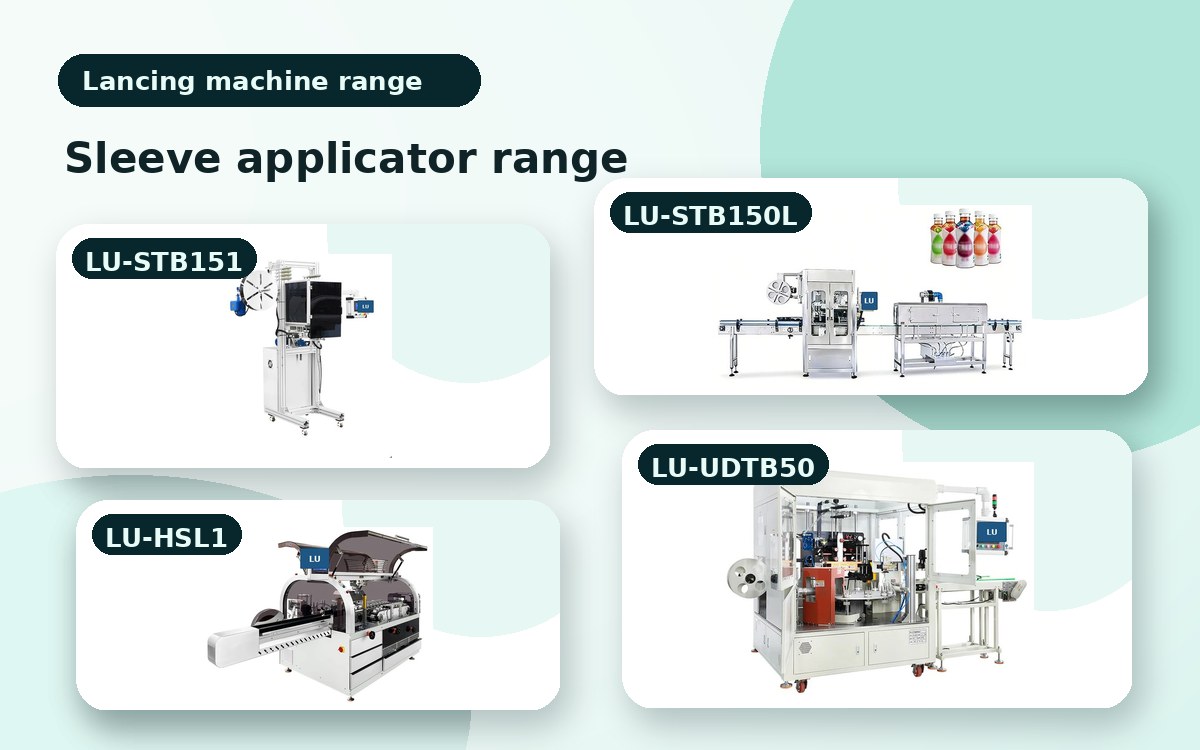
Machine range
Check which existing machine route can support the full format matrix and the required changeover method.
Open guidance →Multi-format capability
One sleeve applicator can often run several container sizes, but compatibility is not proved by diameter alone. Each format has to fit the machine’s supported container and sleeve envelope, remain stable through handling, open cleanly over the relevant former or mandrel and shrink acceptably in the selected tunnel. Some changes are recipe-based; others require guides or mechanical change parts.
Answer in brief
A shared applicator is realistic when each container remains stable, each sleeve opens over the appropriate former or mandrel, the cut and placement positions can be repeated and the selected tunnel can shrink every format acceptably. The format range should therefore be assessed as a matrix of container geometry, sleeve dimensions, handling route and thermal response rather than one nominal diameter.
Record the smallest, largest, lightest and least stable formats, together with required guides, change parts, recipes and verification samples. A useful changeover definition states what the operator adjusts, what must be physically replaced and which pre-tunnel and cooled-pack checks release the next format for production.
Decision framework
Use this as a project-control framework. Final suitability depends on the actual container, closure, sleeve and production condition.
Buyer question
The important dimensions include container height, maximum width or diameter, the shape through the sleeved area, shoulder and base transitions, closure envelope and the required sleeve position. Sleeve lay-flat, cut length and opening behaviour must also stay within the applicator’s proven range. A container family should be checked as complete pack-and-sleeve combinations rather than as bottle diameters in isolation.
Use controlled drawings or measured samples and identify the formats at the dimensional and handling extremes.
Buyer question
A recipe can store settings such as cut length, sensor offset, conveyor speed and timing, but software cannot alter a physical guide, former, mandrel or stabilising component. Change parts are needed when the pack or sleeve cannot be controlled reliably by adjustment alone. The quotation should state which parts are shared, which are format-specific and how each change is identified.
The changeover and spares guide explains how to document the set.
Buyer question
Test the smallest and largest formats, but also include any pack that is unusually light, tapered, flexible, top-heavy or artwork-critical. The format that challenges handling may sit between the size extremes. For each one, record reel feed, cut repeat, pre-tunnel sleeve position, tunnel finish, stops, restarts and the time and actions needed for changeover.
Use a trial matrix that names the exact container, closure, sleeve reel and tunnel recipe.
Buyer question
Early feasibility work can use representative material, but final approval should use the intended sleeve construction and print control wherever possible. Changes in lay-flat, stiffness, friction, static, seam, ink coverage or registration mark can alter feed and opening behaviour even when the nominal dimensions are unchanged. Any temporary trial material should be recorded as a limitation, not treated as final proof.
See the sample-testing guide for retained evidence.
Continue the decision
Use the connected pages to turn the answer into a controlled machine and trial brief.
Check which existing machine route can support the full format matrix and the required changeover method.
Open guidance →Work through container stability, sleeve dimensions, artwork, tunnel route, output condition and integration.
Open guidance →Turn the format list into controlled dimensions, samples, utilities, interfaces and acceptance evidence.
Open guidance →Application review
Lancing can review the container, closure, sleeve reel, required position, shrink route, output condition and integration boundary before recommending an applicator configuration or sample trial.