Bottle sleeve line with tunnel
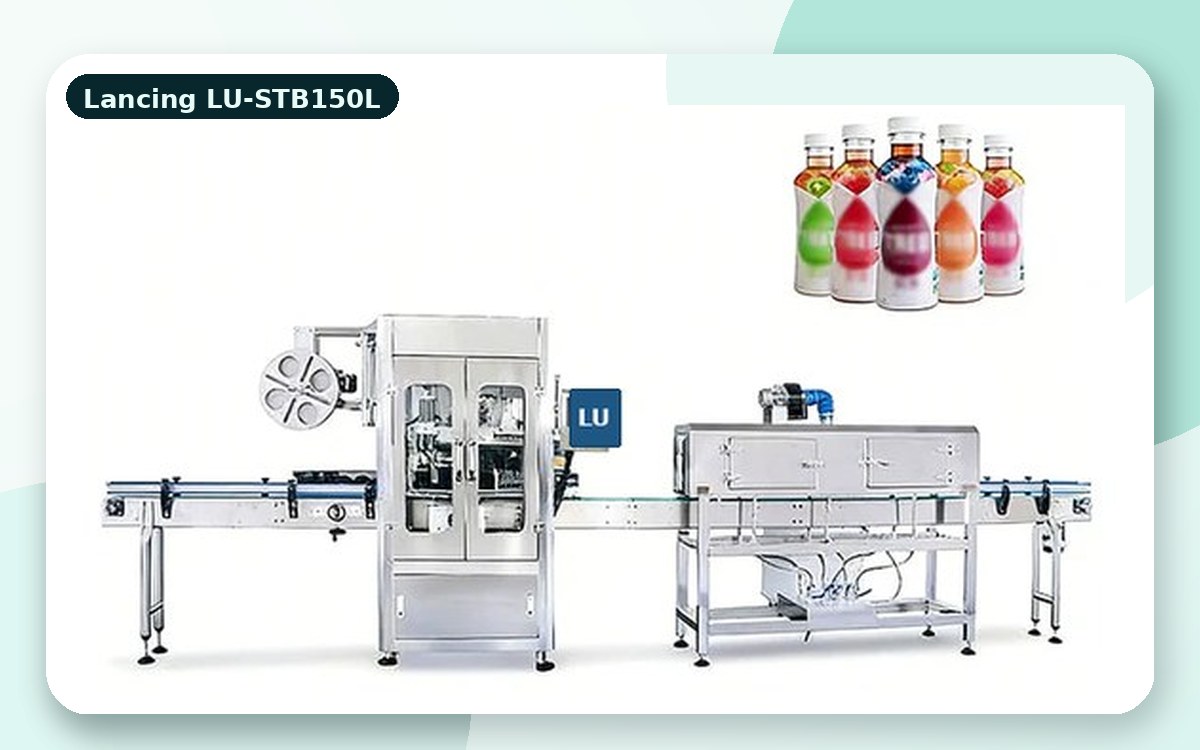
LU-STB150L Bottle Sleeve Labelling and Shrink Tunnel Line
A complete automatic sleeve labelling and shrinking line for full-body sleeves or tamper-evident bands on round, square, oval and shaped bottles.
Where this machine fits
LU-STB150L for real sleeve applicator projects.
High-speed bottle sleeving where the applicator, conveyor and shrink tunnel need to be specified as one system.
This page gives a practical shortlist view. Final selection should still be confirmed against your actual container samples, sleeve material, sleeve lay-flat, cut length, target output and tunnel requirements.
Best-fit applications
- Full-body decorative bottle sleeves
- Tamper-evident bands on bottles and closures
- Food, drink, cosmetics and daily-chemical containers
- Production lines needing applicator plus tunnel planning
Technical overview
LU-STB150L key specifications.
Use these figures as a starting point for line planning. Customisation, tooling and sample testing can change the final specification.
Related Lancing LU models
Compare this model with other sleeve applicator routes.
Different packs may need a compact applicator, a complete applicator-plus-tunnel line, rotary sleeve handling or horizontal product transport.
Project support
Send samples and sleeve data before committing to a model.
Lancing can review the container, sleeve, tunnel route, utilities, output and layout before recommending the correct sleeve applicator configuration.
Application qualification
Qualify the LU-STB150L against the real container, sleeve and tunnel.
The existing technical table gives a published starting envelope for the LU-STB150L. The final order specification should identify which figures are standard, which need customisation and how each difficult format will be proved with production-like samples.
Treat the applicator, conveyor, steam or heat process and finished-pack inspection as one line. A speed test is meaningful only when the agreed label length, container stability, sleeve material, tunnel recipe and reject criteria are recorded.
Cutter, feed and registration
Record whether each sleeve is cut to a fixed repeat or to a printed registration mark. The registration contrast, mark location, seam and reel direction should be reviewed together so the sensor and cutter act on the intended print repeat.
Inspect cut sleeves before shrink. A ragged edge, partial cut or length variation should be corrected in the feed and cutting process rather than hidden by tunnel adjustment.
Tunnel and artwork qualification
Use the film supplier’s shrink-curve information to plan the initial tunnel route, then prove the result on the actual container. Measure top and bottom coverage, seam orientation, shoulder and base finish, artwork distortion and barcode readability after the pack has cooled.
Where steam is used, include extraction, drainage and any drying step in the line trial. Where a dry heat route is proposed, record airflow or zone settings and confirm that the container, cap and product are not damaged.
Changeover and line integration
List the format parts, former or mandrel, guides, recipes and operator adjustments for every approved SKU. Check the time and access needed to remove tooling, clean the film path and recover the line after a normal stop.
The layout should show the capping discharge, product spacing into the applicator, tunnel entry and the point where cooled packs are coded, inspected, accumulated or packed.
Evidence pack for quotation and trial
- Filled and empty containers from both ends of the approved range
- Controlled sleeve reels with material, thickness, cut repeat and artwork revision
- Finished sleeve measurements, barcode and perforation acceptance criteria
- Required good output and the line conditions for the performance run
- Steam or electrical utility data, extraction, drainage and drying requirements
- Layout showing conveyor heights, line direction and adjacent machinery
Buyer questions
Qualify the LU-STB150L against the real container, sleeve and tunnel. buyer questions
Does the published 150 bottles per minute apply to every sleeve?
No. The current page states that output depends on label length. Final good output should be agreed for the actual container, sleeve and tunnel conditions.
How is the 30–250 mm label length confirmed?
Use the controlled cut length from the sleeve drawing and prove feeding, cutting, placement and shrink on representative reels. Custom requirements should be closed in the final specification.
Can printed sleeves use a registration mark?
The print repeat and registration-mark arrangement should be supplied for review. The final sensor and cut method must be confirmed against the actual reel.
Should barcode checks be part of the trial?
Yes when a barcode is carried by the sleeve. Readability should be assessed on cooled finished packs from the intended shrink process.
Is the steam generator the only site utility to consider?
No. The project should also address electrical supply, extraction, drainage, drying, conveyor interfaces and service access.
Can the line connect to existing filling and capping equipment?
It can be planned as an integrated line, but conveyor height, product pitch, controls, accumulation and responsibility for each interface must be confirmed on the layout.
Integrated-line acceptance
Test the LU-STB150L as a joined applicator, conveyor and shrink process.
The LU-STB150L source data covers bottle diameters of 28–125 mm, heights of 30–280 mm, sleeve cut lengths of 30–250 mm and film thicknesses of 0.03–0.13 mm, with PVC, PET and OPS listed. These ranges should be treated as separate published references, not proof that every extreme combination will run at the maximum published rate.
Control sleeve material and artwork as production inputs
The material list does not mean that PVC, PET and OPS share one tunnel recipe or one stable application window. Record the film supplier, thickness, shrink-curve information, seam construction, reel direction, registration mark and artwork revision for each approved format. Recheck the application when any of those controlled inputs changes.
Where a barcode, fine text or opening instruction crosses a high-shrink area, assess it on cooled packs produced at the intended rate. A readable flat artwork file is not evidence that the printed feature will remain usable after the sleeve has moved around a shoulder, corner or base.
Line scope to close before approval
- Applicator and tunnel handover points and the responsibility for each conveyor section
- Steam, extraction, drainage and drying requirements confirmed for the site
- Upstream bottle spacing and downstream back-pressure conditions reproduced in the test
- Change parts and recipes listed against every approved container and sleeve
- Measured unshrunk and cooled samples retained with the rate-test record
- Wider filling, capping, inspection and end-of-line interfaces defined separately where required
For the wider production-line scope, use Packaging Lines UK; keep the sleeve application and tunnel qualification on this domain.
Send the LU-STB150L format matrixIntegrated-line acceptance
Accept the LU-STB150L applicator, conveyor and tunnel as one controlled process.
A complete line should be tested with the actual pack range, sleeve reels and finished-pack criteria. The applicator can place a sleeve correctly while a transfer, queue or tunnel condition later moves or distorts it, so acceptance must cover the full route.
Existing production line
Use the retrofit guide to survey space, conveyor and controls before layout approval.
Finished-pack release
Use the quality-control guide to separate application and tunnel defects.
Integrated-line acceptance
Test the LU-STB150L output reference as an applicator, conveyor and tunnel system.
The published output of up to 150 bottles per minute should be linked to a named container, sleeve cut length, material, artwork, conveyor pitch and tunnel recipe. The accepted figure should be sustained good output after the pack has passed through the complete line and cooled sufficiently for inspection.
Testing only the applicator cycle does not prove the finished process. Back-pressure, infeed gaps, tunnel warm-up, utility variation, downstream accumulation and controlled restarts can change the result seen in production.
Define the integrated test boundary.
- Infeed pitch, stability and no-container/no-sleeve response
- Registration, cutter repeat and applied height before the tunnel
- Tunnel warm-up, conveyor speed, utilities and extraction condition
- Coverage, seam, artwork, barcode and container condition after cooling
- Back-pressure, stop, restart, reject and reel-change behaviour
Use format extremes and difficult artwork.
Run the dimensional extremes and any pack with a demanding shoulder, base, seam position, barcode or perforation. The largest diameter is not automatically the hardest format.
Use the sample-testing guide and quality-control guide.
Discuss the LU-STB150L line test